Showing posts with label Captain Marryat. Show all posts

Saturday, 17 June 2023

Frederick Marryat, Part 2

Part 1 is here
The success of Marryat’s first novel launched him into the literary world of 1830s London and was soon followed by publication of The King’s Own. Of this a modern reviewer says:
It is apparent that Marryat intimately knows the sea, its sailors, and its unforgiving nature. The scenes of naval conflicts are conveyed with a natural continuity that preserves the chaotic and horrific details of men fighting each other with cutlasses, on the decks of ships made of wood, and moved by canvas. He’s also familiar with the humor that permeates naval life either in the form of the antics played on fellow seamen or in the irony associated with naval commanders trying to shift blame away from their own shortcomings.

Beyond the sea, Marryat instills reality into his characters. He constantly brings forth small universal truths that support the actions and behaviors of his characters, which adds a greater depth or deeper meaning to his story.
With these novels Marryat inaugurated a literary genre explored by, for example, C S Forester with his Hornblower books and Patrick O’Brian’s best-selling Aubrey–Maturin series.

Marryat’s blend of authentic detail, fast-moving action and humour was to become his authorial trademark and gained for him a wide readership. The King’s Own was followed by Newton Forster or, the Merchant Service (1832).

With Jacob Faithful and Peter Simple (1834), he began to write also for a younger audience, and he may be best remembered as a children’s author, especially for The Children of the New Forest (1847).

His other works are as follows: Jacob Faithful (1834), The Pacha of Many Tales (1835), Japthet in Search of a Father, The Pirate, The Three Cutters, Mr Midshipman Easy (1836), Snarleyyow, or the Dog Fiend (1837), The Phantom Ship (1839), Diary in America (1839), Poor Jack, Olla Podrida (1840), Masterman Ready, Joseph Rushbrook (1841), Percival Keene (1842), Monsieur Violet (1843), The Settlers in Canada (1844), The Mission, or Scenes in Africa (1845), The Privateer’s Man, or One Hundred Years Ago (1846), The Little Savage, Valerie (both published posthumously in 1848).

From 1830 until 1843 Marryat divided much of his time between London, Norfolk and the fashionable Regency resort of Brighton. In 1832 he became the editor of the Metropolitan Magazine, and was a friend and contemporary of Charles Dickens and Samuel Rogers, among other luminaries of the literary world.

In 1836 he lived for a time in Brussels, and in 1837-8 travelled in Canada and the United States. One of his reasons for going to America had to do with the fact that American publishers regularly pirated British works, but his efforts in this regard failed. Dickens too was angered by American freeloaders, the more so when the American press told him he should be grateful for the exposure and was mercenary in expecting to be paid.

Marryat in middle age

Marryat’s marriage, unhappy for a long time, broke down in 1843 and he moved to his estate at Langham, taking up residence in the recently built Manor Cottage on the Cockthorpe Road – ‘cottage’ being a misleading word for such an imposing house, but considered appropriate because its roofs were thatched. Here, with the sea distantly in view, he received a visit from Charles Dickens and wrote his last novels.

Once settled in the village, Captain Marryat took a prominent part in its affairs, supervising his own estate, on which he installed a duck decoy; he shrewdly hired as his gamekeeper one William Barnes, a prolific local poacher. Marryat became a magistrate and churchwarden and was appointed Deputy Lieutenant of Norfolk.

But the malaria he had contracted as a youth had permanently damaged his health. Matters had not been helped by the almost inhuman rate at which he had written since leaving the Navy.

In 1847, perhaps hoping a change of air would help, or perhaps because this restless, creative man had simply become bored, he applied to rejoin the Navy. The Admiralty’s curt rejection of his application so angered him that he broke a blood-vessel of the lungs and was dangerously ill for months.

Just as he was recovering, news came of the drowning of his eldest son, Frederick. He had gone down on 20 December 1847 in the paddle-frigate Avenger while off the north African coast.

The shock and subsequent grief proved too much for a system weakened by disease and overwork, and Frederick Marryat died at Langham on 9 August 1848. His tomb in the churchyard is now looking a little forlorn, a sad reminder of what awaits even the best, brightest and most energetic of us. The unalloyed pleasure given by his fiction is a far better and living legacy: that and the enduring annals of his bravery and his humanitarianism.


Saturday, 10 June 2023

Frederick Marryat, Part 1

Frederick Marryat, Captain Marryat as he became, is the most celebrated person ever to have lived in Langham, though he only moved here permanently at the age of 51 and died five years later. Indeed, a loke in the village is named after him.

He was characterised by a naval historian as follows: ‘… energetic beyond the ordinary, gifted in diverse ways, never common-place, uncertain in temper and behaviour, and, like many other men and women, tending to overvalue the past as it receded.’

He was born in London on 10 July 1792 to Joseph Marryat and his wife Charlotte (née von Geyer), an American from Boston of German descent. Frederick’s grandfather was Dr Thomas Marryat, the eccentric physician and wit who had died in Bristol just before Frederick’s birth.

Joseph Marryat was descended from Huguenot refugees who had come to England following the St Bartholomew’s Day massacres in 1572. He was very wealthy, not only by inheritance and marriage, but also from his own activities: he was a shipowner and the Chairman of Lloyd’s, and became Tory MP for Horsham and then Sandwich. He had invested in plantations in the West Indies, was colonial agent for Grenada, a slave-owner himself and a strong anti-abolitionist. The family lived at Sydenham and Wimbledon.

Frederick, the second of fifteen children, was educated at Mr Freeman’s academy, Holmwood School, at Ponder’s End, Enfield, where one of his classmates was Charles Babbage, the polymath later credited as the father of the digital computer.

Frederick’s boisterous character often got him into scrapes: he ran away from school twice with the idea of going to sea. So determined was he that his father arranged for him to join the naval frigate Impérieuse, 38 guns, under Captain Lord Cochrane, which he did as a midshipman in September 1806, aged 14. He served thereafter in various vessels and saw much action. In 1809, during the ill-fated Walcheren Campaign, the young Marryat caught the so-called ‘Walcheren Fever’ (malaria) which killed nearly 4000 British troops and troubled him for the rest of his days.

Evacuation of ailing British troops from Walcheren, 1809

He was returned to England aboard HMS Victorious.

In 1810 he was serving in the Mediterranean aboard HMS Centaur, the flagship of Sir Samuel Hood; in 1811 he sailed to the West Indies and North America on HMS Aeolus and later served aboard HMS Spartan. In September 1812 he was sent home aboard the Indian.

He passed for lieutenant that October. However, because he had not been christened ‘according to the rules of the Established Church of England’, promotion was delayed until 26 December. In January he joined HMS Espiègle and returned to the West Indies, but in April his health declined and he was invalided. Although in 1814 he joined the frigate HMS Newcastle under Captain Lord George Stuart, fighting American privateers, his health again let him down and he was sent home.

Marryat as a young man

In 1815, promoted commander, he served aboard the sloop HMS Beaver off the island of St Helena, to prevent any attempt to rescue Napoleon Bonaparte from his exile there, but Marryat’s health was still poor and he left the ship at Madeira.

He had always been interested in science, and in 1818 he published his design for a lifeboat, for which, and for his selfless courage in rescuing people at sea, he was awarded the honorary gold medallion of the Humane Society. A year later he married Catherine, the second daughter of Sir Stephen Sharp, for many years Consul-General in Russia. And in the same year, 1819, under the aegis of Charles Babbage, he was elected Fellow of the Royal Society for his A Code of Signals for the Merchant Service, published in 1817. Sales of this work earned him a substantial income and in 1833 he was awarded the Légion d’honneur, which, ironically, had been instituted by Napoleon in 1802.

Unlike his father, Frederick was a radical at heart: at about this time he published articles critical of the practice of impressment for recruiting seamen, but these were badly received by the establishment.

In 1820 Marryat was in command of HMS Beaver, again on guardship duty around St Helena. But Napoleon was already dying. General Bertrand in his notes (page 261, Les Cahiers, 6 May 1821) says, ‘At 10 o’clock Mr Ibbetson and the frigate Captain Marryat came to draw the Emperor on his deathbed. It appears Mr Marryat had achieved a fairly good likeness’.


Marryat later made various versions of this sketch, some of which were turned into engravings and widely published in Britain, such was the enduring fascination with ‘the Antichrist’, as he is called by Anna Pávlovna Schérer in War and Peace.

In 1824 Frederick was the senior naval officer at Rangoon and fought in the First Anglo-Burmese War, being the first Royal Navy officer to use a steamship in wartime. He joined another ill-fated, disease-ridden expedition, this time up the Bassein River; the following year he was given the command of HMS Tees. In 1826 he is recorded as returning to England; on 26 December he was nominated a Companion of the Bath. In 1829, commanding the frigate HMS Ariadne, he was engaged in chart-marking in the treacherous waters around Madeira and the Canaries.

His semi-autobiographical novel, The Naval Officer, or Scenes in the Life and Adventures of Frank Mildmay, was published that same year; he had already drafted The King’s Own.

Joseph Marryat had died in 1824. In 1830 his son Frederick, endowed with a patrimony of half a million pounds and weary of the dangers and privations of the sea, decided to embark on a literary career. He resigned from the Navy, sold his family residence at Sussex House, Hammersmith, and purchased an estate of a thousand acres at Langham, though he was not to settle there until 1843.

The first and most turbulent period of Captain Marryat’s life was over; his chief fame was yet to come.

Friday, 26 May 2023

The village sign

The Langham village sign, situated on the green, was made in 1979 by Harry C Carter and restored in 1998. It is surmounted by a bishop’s mitre – in 1086 the eastern part of the tenancy of Langham, which includes the present-day church, was granted to William de Beaufeu, Bishop of Thetford. The mitre depicts the English flag, which at one time was also the pre-eminent maritime flag, known as the white ensign. That leads us, anticlockwise, to the sailing ship which commemorates not only Langham’s associations with the sea but also Captain Marryat, who came to live here in 1843.

The next quarter depicts the landmark church tower, of course, with its distinctive stair-turret. The Domesday Book lists two parishes in Langham, Bishop’s Langham or Langham Magna and Langham Parva, the latter being granted in 1086 to Peter of Valognes, William the Conqueror’s uncle, who, incidentally, provided land for the construction of Binham Priory, which was founded in 1091.

The two parishes were later united and the Langham Parva church (St Mary’s, situated on the north side of Cockthorpe Road where it forks from Binham Road) fell into disuse and was eventually demolished. The existing, Langham Magna, church was dedicated to St Andrew, the patron saint of fishermen and agricultural workers, among others, and acquired its double dedication when St Mary’s was no more.

The name lives on in ‘St Mary’s Lane’, one of the names chosen by the District Council in the 1970s when the housing estate of that name was built on the site of the former barracks for RAF Langham.

The next quarter celebrates the chief industry here, and the last refers to the turkey farm on the old airfield, which in 1979 was run by Bernard Matthews.

Village signs of this kind are frequent in Norfolk and Suffolk; let’s compare Langham’s sign with those in some neighbouring villages.

In what follows we are indebted to Adrian S Pye, who has made a special study of village signs and licensed his text and images under a Creative Commons licence.

He writes, ‘The design usually depicts a particular feature of the village, or a scene from its history, heritage, or culture. The signs are typically made of wood or metal or a combination of both. Modern cast and fibreglass signs are becoming more commonplace; the less elaborate are often made within the local community.

‘The tradition of village signs is believed to have started in Norfolk early in the 20th century when Edward VII suggested that village signs would aid motorists and give a feature of interest on the Sandringham Estate.

‘The interest soon spread beyond Norfolk, and can be attributed to Prince Albert, Duke of York (later George VI) who gave a speech to the Royal Academy in 1920 promoting the wider use of village identity signs.

‘In 1929, Harry Carter, an art and woodwork master at Hamond’s Grammar School (which now serves as the sixth-form buildings for Hamond’s high school in Swaffham), carved a sign for his home town. By the time of his death in 1983 he had carved over 200 town and village signs.

‘Acknowledgement must be made to the Women’s Institute, who sponsor many of the signs and present them to the villages and towns in their county.

‘While the practice is now widespread, decorative village signs are particularly common in Norfolk and Suffolk as well other East Anglian counties. Some village signs take the form of sculptures, such as those at Stibbard, Corpusty and Walpole St Andrew, which are constructed entirely from metal.’

Binham

Image credit: Jane Rackham; licence

The sign simply depicts the priory for which the village is famous.

Blakeney

Image credit: Pauline E; licence

‘The sign is surmounted by two hammers (known locally as bietels) and a chestnut. This refers to a local nonsense rhyme “Blakeney people go up the steeple to crack a nut with a five-farthing bietel”.

‘An English galleon, one of three from the village on the way to fight the Spanish Armada, is the primary feature of the Blakeney village sign. The mallard duck and drake represent the bird sanctuary, and fish forming the spandrels are a further reference to the strong maritime connection. The boy with a fiddle and the cave in the cliff relates to a legend in which the boy (and his dog apparently) tried to fiddle his way to Wiveton via a tunnel from which he never emerged and which itself disappeared. Strange that!’

Hindringham
Image credit: Adrian S Pye

‘The sign is carved out of oak and celebrates the 25th year of the reign of Queen Elizabeth. It depicts the church and the mill as well as the unique 12th century chest which is in the church.’

Stiffkey

There are no fewer than four village signs in Stiffkey, three of them at the limits of the village, depicting a common tern perched on a post.
The principal sign, near the church, reminds us of one of the traditional pronunciations of the name, the other being ‘Stuckey’. It is dominated by a representation of cockle-gatherers and a Stiffkey blue or Stiffkey blew, the blue-shelled cockle found locally. The chalice and pig refer to the Bacon family, who lived at Stiffkey Hall.
Image credits: Theo Foster; licence

Bale

Bale’s sign commemorates the Bale Oak which once occupied a site next to the churchyard.


There is a painting in the church giving an idea of the tree’s appearance:


and below it a typewritten note:
The
GREAT BALE OAK
at
BALE alias BATHLEY

This picture is a reconstruction of the Tree as it would have appeared before it was pollarded in about 1750, in a vain effort to stimulate it to new growth.

The painting is based upon the following facts.

1. A drawing in the “London Illustrated News” for May 17th 1845.

2. A drawing made some time in the 1850s by some connection of the Jones family of Cranmer Hall near Fakenham, who were at that time Lords of the Manor of Bale Nogeons and Thorpes. This was reproduced in the Eastern Daily Press in May 1967.

3. An oil painting shewing the tree prior to the pollarding but not dated or signed. This is owned by D. H. Hammond Esq. [of] Bale Manor next door to the church.

 – – – – – – – – – – – – – –

In the picture The Cobblers’ tools referred to the shoemaker who used the hollow Tree for the whole of one summer as his shop.

The Pig is there because in the Frere MSS., which are the unpublished material sent to Blomfield for his Norfolk history (he died in 1752), it is said that the inside of the tree was used as a “swinesty”, i.e. a place to keep swine in.

The Raven is a reminder that the Tree probably was a sacred oak, which was why the Christian church was built beside it. The Raven was the constant companion of Thor, the chief of the gods of the Saxon–Norse mythology.
Here we see a connection with the Viking raiders who plagued the east coast in the last two or three centuries of the first millennium, and who themselves converted to Christianity. The sign itself has a suitably pagan flavour:
Detail of the top, showing the cobbler and swineherd:

Sharrington


The meaning of this sign is unclear, unless it is to indicate that the village is in a land of milk and honey provided by agriculture, which arguably it is. The date (1977) suggests the sign may have some connection with the Silver Jubilee of the late Queen.

Brinton

‘The jolly little character sitting on the sign is John Page, who in his day was a merchant, soap boiler, grocer, draper and tallow chandler, hence the two candles. The candle factory still exists in the form of Chandler’s Cottage.’


Gunthorpe


‘The sign is carved in wood and shows various periods in the history of the village. A wheatsheaf indicates that the village is agricultural and has been for most or all of its existence. A tree and four pigs, dated 1086, tell us that Gunthorpe was mentioned in the Domesday Book and had woodland and four pigs. Below is a dog peering at a crown, with the date 1201: this recalls, and I quote, William, son of Robert le Mey, had 20s. lands, formerly the King’s demean, granted by Henry I. and held with Causton, by grand serjeanty, the keeping a hound (brachettus) for the King. In 1678 the poor have 25s. a year out of Malthouse Pightle, left by Christopher Ringer, and in 1777 John Towne makes a similar gesture. A cottage loaf, bottom right represents the legacy. In 1747, Isaac Le Heup of Gunthorpe, local gent and landowner, died. He is represented by a gravestone bearing the initials I L.’

Langham’s sign is up there with the best of them in terms of symbolism and craftsmanship. Thank you, Mr Carter. Long may it stand!

Saturday, 20 May 2023

Captain Marryat’s duck decoy

Captain Frederick Marryat, who will feature in later posts on this blog, retired from a distinguished naval career and in 1843 settled at Manor Cottage, which occupied the site of the large house of the same name on the south side of Cockthorpe Road (the last but one you pass when leaving Langham). He was a successful novelist: his most popular and enduring book is Mr Midshipman Easy.

One of his projects was the construction of a duck decoy in the valley of our tributary of the River Stiffkey, east of the road to Binham, and he flooded there a hundred acres for the lake and pipes, a probable trace of which is depicted on an Ordnance Survey 1:2500 map, prepared in 1886 and published in 1887. The site is to the east of Bluemount Plantation.

Somewhat further upstream the Phelps family have recently excavated ground to form wetland, both for its wildlife value and the purifying and oxygenating effect it will have on the water. Much of that valley from Binham to Langham remains wild, though except for Binham Moor where it is crossed by a permissive footpath the land is closed to the public.

Duck decoys once killed huge numbers of wildfowl, most of which were sold into the poultry trade. At its height, Marryat’s decoy was supplying the London market with 5000 birds a year.

Since duck decoys are admirably documented in With Nature and a Camera by Richard Kearton (Cassell & Co., London, 1906), and since that work is now in the public domain, we cannot do better to describe them than reproduce the relevant text here. The decoys Kearton visited were in ‘East Anglia’, but from the description none of them is likely to have been Captain Marryat’s.

THE ART OF DUCK-DECOYING

Of all the contrivances invented by the ingenuity of man for the capture of wildfowl, I think a duck decoy is at once the most interesting and the most deadly. The first one made, and worked by enticing the birds into it, in this country was, it is believed, that constructed by Charles II in St James’s Park.

Some idea may be gathered of the effective nature of this engine of destruction when it is mentioned that about a century ago no less than 31,000 wildfowl of various species were taken in a single season by ten Lincolnshire decoys.

The precision of modern firearms and the great increase of gunners of all kinds have almost reduced decoying to a lost art. However, there are still a few pipes, as the contrivances are called, worked in different parts of the country; and the man who looks after those I am about to describe – three in number – succeeded last winter in killing 1,500 head of wildfowl, despite the fact that he was not working upon an ideal piece of water, and was continually harassed by a number of flight shooters, who waited for his birds in some adjoining property, over which he had no control, and blazed off at them almost every morning and evening, as they came in from and left again for the mud flats by the sea.

Successful duck-decoying can only be carried on by the fortunate combination of several important essentials. (1) Perfect quietness upon the body of water, large or small, to which the birds come to spend the day. (2) A good set of well-kept pipes, each trending to a cardinal point of the compass, for it is absolutely necessary when a pipe is worked that the wind shall be blowing from the tail of it; for ducks always swim and fly with their heads to the wind. The pipes are, for this reason, named from the direction in which they point. (3) A well-trained, intelligent dog of small size, quick action, and silent habits. If it resembles a fox in colour so much the better, but this qualification is not now considered so essential as it was in olden times, when the decoy-men attached so much importance to it that they tied the skin of a fox on to a dog’s back, and allowed the brush to trail upon the ground. (4) A number of well-trained lure ducks that will come to the decoy-man’s whistle or the sight of his dog, and swim steadily up the pipe; and last, and most important of all, a man of more than average industry, intelligence, and skill.

In order to make this chapter as complete as possible, from a pictorial point of view, we journeyed twice to East Anglia; once, when the wildfowl were being actually caught, and it was impossible for us to photograph the mouth of the pipe without frightening the fowl away; and again in summer-time, when we could go anywhere without fear of doing harm.

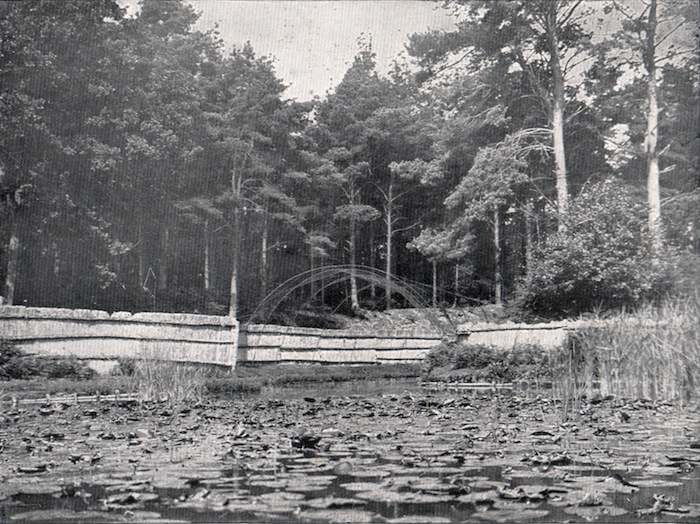
A decoy pipe is a ditch shaped somewhat like a cow’s horn or an ear trumpet, and is sufficiently curved to make it quite impossible for anything going on at one end to be seen from the other. It is about one hundred and fifty feet in length, seventeen or eighteen feet wide at its mouth, and gradually tapering to a couple of feet at its tail. The water in it is about fifteen inches deep at the wide end, and three or four at the narrow one. If a spring or small stream should empty its waters into the pipe, it is considered an advantage, as wildfowl swim better against a slight current.

ENTRANCE TO DECOY PIPE

The pipe is covered by iron hoops, commencing at the mouth with one having a span of from twenty-five to thirty feet, and a height, from the centre of the arch to the water, of something like fifteen feet; the hoops gradually diminishing in size as they approach the tail of the pipe to about two feet in diameter.

The whole is covered by a hand-spun hemp net, with a two-inch mesh, well coated with tar and tan. I was assured by the decoy-man that one of these nets will last twenty years. Some pipes are covered by a four-inch mesh at the mouth, and for some distance down, and then one of half the diameter.

One decoy we examined was covered with galvanised wire, which had been treated in the same way as a hemp net. Some decoy-men have an objection to wire netting, on account of its tendency to hum in a breeze of wind, and thus frighten the ducks away; however, the man we visited experienced no difficulty of this kind.

At the tail of the decoy pipe is a detachable net from twelve to fifteen feet long, held open by hoops two feet in diameter, and lying on the ground. In some cases a kind of hopper is made close by the end of the receiving net, to throw the dead fowl into.

DECOY PIPE FROM TAIL END
On either side of the mouth of the pipe the banks slope gently down to the water’s edge, and are flat and roomy, especially on the side where the sunshine falls, in order that ducks may land to preen themselves and sleep thereon. These banks extend for more than half way up the pipe, gradually narrowing as they do so, until they vanish altogether, and the hoops and netting come close down to the water’s edge. On the screen side, or left bank from the entrance, and about one-third of the distance in, we found a wire cage let into the bank containing a couple of lure ducks; but this is a dodge, I believe, peculiar to the man whose pipes we visited. No leaves or twigs are allowed to accumulate upon the pipe, and overhanging branches or shrubs, calculated to darken any part of it, would be instantly lopped off.

On the left hand side from the entrance is a double row of reed screens, about five feet in height, running parallel with the pipe for something like two-thirds of its length. The outer is a plain one, with gaps in it here and there for the convenience of the decoy-man upon entering to examine the pipe. The inner screen consists of a series of pieces arranged in such a manner that the decoy-man can see towards the tail of the pipe without being seen himself by any fowl coming into it or outside upon the lake. Between each piece of this zigzag screen is a small one running at right angles for the decoy dog to jump over. It is about two feet in height. A few yards in front of the mouth of the pipe is the head show place, where the decoy-man first shows his fear-inspiring form when the wildfowl are well within the pipe. A few yards further along on the same side is a cunningly devised hole for the dog to creep through when the luring commences. Behind the two screens there is a great bank of earth with trees and shrubs growing upon it, and in this is a dug-out path by which the decoy-man enters the grounds and takes his departure.

The screens are made of dead reeds, and are five or six inches thick. They are held close together by wooden rails or galvanised wire. The decoy-man told us that the latter is far better, as it does not collect and hold the water behind it, to rot the reeds, like a wooden rail.

ZIGZAG SCREEN
Stuck through the inner or zigzag screens, commanding a good view of the pipe mouth and lake, are several dagger-like pieces of wood, a foot in length and an inch and a quarter wide, which, when turned on one side, open a small vertical slit in the reed screen, through which the decoy-man makes his survey.

PEEPHOLE IN SCREEN 
All the paths are swept clear of twigs and leaves, and covered with a thick layer of sawdust, so that the decoy-man’s footsteps may not be heard.

The lure ducks that are at liberty in and around the mouth of the pipe number about twenty, and are very similar in appearance to wild Duck. They are only fed in the evening, after the wild ones have left for the mud-flats, except at such times as when the decoy-man is at work catching fowl, when he flings bruised oats, buckwheat, maize, malt grains, or acorns into the pipe.

As soon as the lure ducks hear the decoy-man’s low whistle, or see his dog, they know there will be some grain floating down the pipe, and they swim up – the steadier the better, for these ducks are so trained that as soon as the decoy-man appears at the head show place, and the wild birds rise and fly up the pipe, they quietly swim down again towards the lake.

Wildfowl are taken between October and March; and during a hard frost the decoy-man puts on his sea-boots at midnight, and, taking a long-handled axe and boat-hook, cuts up the ice round the mouth of the pipe, and thrusts it beneath that formed upon the lake. It is a great point in successful wildfowling to keep the water in the pipe, and for some distance around its mouth, free from ice, as such birds as frequent the lake during open weather bring a lot of strangers back with them on their flights to the coast during a snap of hard frost.

Many decoy-men are too anxious to begin to kill the wildfowl directly they visit their water. It is a great mistake, because, if they kill them nearly all at the beginning, the few remaining birds do not induce many strangers to fly back with them from the mud-flats in the morning. Ducks fresh from the sea are known by a mark upon their breasts, left by the salt water, but this quickly disappears when they frequent fresh water.

As wildfowl are very acute of scent, a piece of burning turf is taken by the decoy-man when he goes after Duck, in order to counteract the smell of his breath or clothes. This strange proceeding, according to Sir Ralph Payne Gallwey, had its origin in the fact that “in the fens of Lincolnshire turf was largely burnt before coal came into use, and it was supposed that the wildfowl, being accustomed to its smell, did not mind it, whereas they would that of the decoy-man.”

I will now endeavour to describe how the actual work of taking wildfowl is done.

We trooped silently down the sunken path leading from a track near the decoy-man’s cottage in the wood to the pipes. He led the way with a piece of burning turf in his left hand, and his little liver-coloured bitch close at his heels. When we reached the screens, he placed his piece of turf upon the ground, and, gently twisting one of the dagger-like sticks from the vertical to the horizontal, peeped through the slit in the reeds, and beckoned us to come and look.

DECOY-MAN MAKING HIS SURVEY

Some two hundred head of wildfowl were to be seen: a few upon the far bank, at the mouth of the pipe, and in the open water in front of it, but the great majority on the ice beyond. Those nearest the pipe appeared to be full of attention and alertness, whilst those further out were either preening themselves or sleeping peacefully. In some places they were collected in dark groups, and in others they were scattered pretty generally over the ice.

The decoy-man quickly twisted the stick back to its original position, and the peep-hole instantly closed. Creeping stealthily forward, he gave his dog a piece of bread, and sent it through the hole in the reed screen, beyond the head show place, and glided swiftly and silently back.

DOG’S HOLE
The dog and he appeared to meet at the head show place at the same moment. It jumped over, and, taking a piece of bread from its master’s hand, jumped back again, and directly afterwards appeared at the next opening, between the zigzag screens. After this performance had been repeated several times, and the decoy-man had thrown sundry handfuls of grain from his jacket pocket into the pipe, he stopped and peeped through one of the screens. A number of wildfowl had followed his dog out of curiosity, or his lure birds after the grain, and, darting through a gap in the outer screen, he ran back at great speed to the head show place, and frantically waved a large red cotton handkerchief. There was instantly a great splatter and commotion, and the decoy-man raced like mad from one show place to another, giving his handkerchief a flick at each as he passed.

The poor ducks flew straight on, heads to wind, no doubt thinking that just round the bend in the little creek was an open glade in the woodland leading to freedom and safety, but, alas! the fatal pipe narrowed, and the much-dreaded man followed, with his waving sheet of flaming red; there was no retreat, and on they went pell-mell, frantically hustling each other to get through the little hole at the end – to find themselves in a treacherous cul-de-sac.

We all ran at the top of our speed along the sawdust path to the detachable net at the end of the pipe, where we found six wild ducks tearing up and down in the greatest fear and consternation. One old mallard had struck his head against an iron hoop supporting the wire netting over the decoy pipe, and was lying flat on his back in the last throes of death.

The decoy-man quickly detached the receiving net, and, taking the wildfowl out one by one, dislocated their necks by a dexterous turn of his wrist.

DECOY-MAN KILLING WILD DUCK
He was distinctly a man of notions, for he told us that he had invented a method for making up for his decline in speed (the result of thirty years’ hard wear and tear at the pipes and gamekeeping) when running from one show place to another along the side of the pipe. He had fixed a red handkerchief on a stick at the next show place to the head one, so that directly he frightened the birds by his appearance he could pull a string and hoist it, and thus prevent any wildfowl in the pipe from turning round and flying back before he reached the place. He also told us that he sometimes uses a tethered lure Duck at the mouth of the pipe, and has an idea that, if a long, narrow mirror were hung across the decoy at a certain height above the water, the birds outside, seeing themselves in it, would swim up, thinking that their reflections represented other and bolder members of their species.

He was, in addition to being a skilled hand at the pipes, a most kindly, good-natured fellow. One morning we visited his cottage at six o’clock, and found him bustling about and feeding some poor old wayfarer, who had dropped in to see him, with liberal supplies of rum and milk and cake. The old fellow, who evidently belonged to the neighbourhood, told us that he remembered the time when smugglers used to hide their contraband goods in the middle of the wood we were then in. One Sunday morning, whilst out for a stroll, he came upon a man guarding a cargo of spirits which was to be taken further inland, and the smuggler begged of him not to inform the authorities.

“Did he give you any, bor?” inquired the decoy-man laughingly.

“That he did,” answered the old man; “an’ I didn’t tell on him nayther.”
Update

From Ralph Payne-Gallwey’s The Book of Duck Decoys (1886), p. 136:
Langham. — Mr. Southwell states that there was a Decoy at Langham, 3½ miles SW. of Cley, constructed for the late Captain Marryat, R.N. (the well-known author.) After his death, in 1854, the property was purchased by Mr. S. F. Rippingall, and the Decoy dismantled.

The site of the Decoy is now a field, with a small stream running through it; plantation, lake, and Decoy all gone. The Rev. E. W. Dowell, who had often seen this Decoy worked, says the proportion of fowl taken was about Wigeon 3, Mallard 2, Teal 1.