Showing posts with label house profiles. Show all posts

Saturday, 29 July 2023

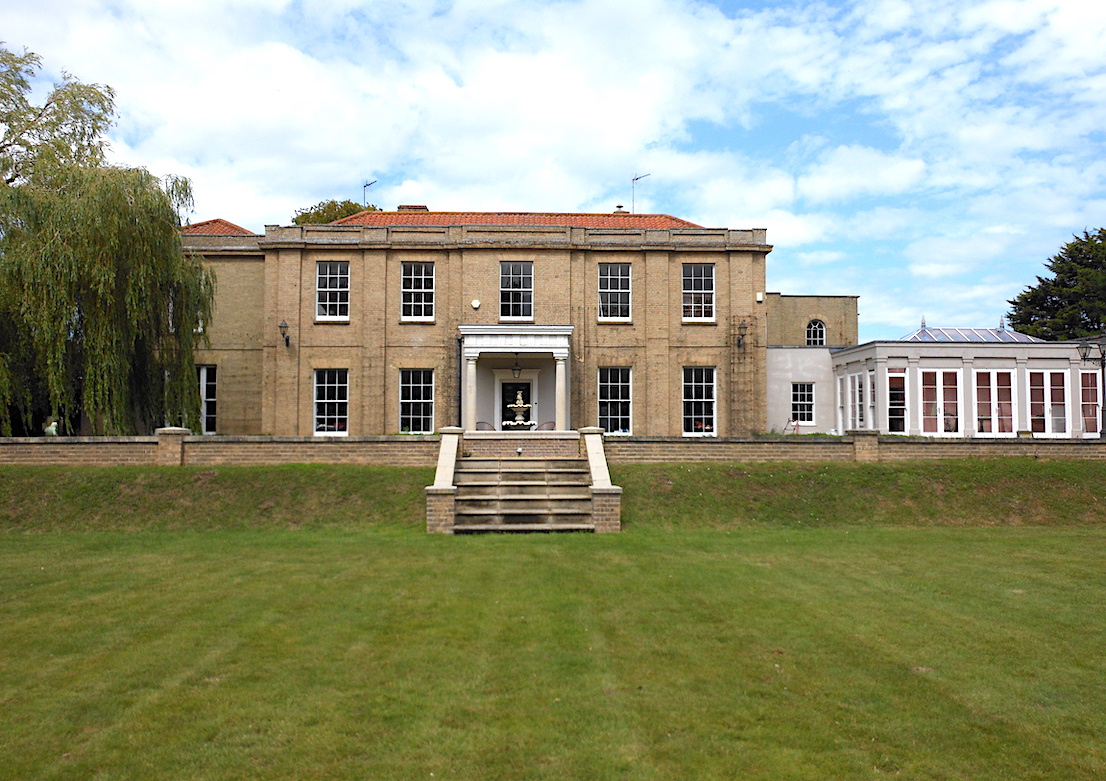
Langham Hall

The Hall was designed by Rev. Stephen Frost Rippingall and built in 1819 for his father, Thomas Rippingall. When Thomas died in 1834 his only surviving son, Stephen, came to live there. He had been a curate at Runton; he married the daughter of the rector and they had twelve children. In 1856 the house was occupied by Charles Rippingall, who then became the Lord of the Manor.

Stephen Frost Rippingall died in 1858, whereupon the Hall and its estate passed to his son William. He farmed there until his death in 1880, when it was bequeathed to his eldest surviving daughter, Horatia. As Lady of the Manor she lived there with her sisters, active benefactresses in the village.

In 1910 she sold the Hall to Carlos E Ryder. In 1916 he bought the Manor House at Binham and his son, Frederick Budd Ryder, took up residence.

In the Second World War the Hall was requisitioned by the RAF as a Casualty Reception Station: some of the less reverent and more active patients amused themselves by shooting at the church clock.

The Orangery

Since then there has been a succession of owners, including Mr M H Armistead, headmaster of a private school in Walsingham: he sold the Hall to Mr R M Peel in 1974 for approximately £55,000. The last-but-one owner was Mr Tony Burlingham, the proprietor of MJB Hotels.

This review seems fairly typical for an MJB hotel. Mr Burlingham himself has also been in the news now and then. The website for ‘MJB Langham Hall Apartments’ is still up and tells us that the ‘3-star Langham Hall Langham lies approximately 2.4 miles away from Blakeney Conservation Duck Pond Animal Park’.

The Hall was recently on the market for £1.95 million and has been purchased by the Cutmore-Scott family to incorporate with their adjoining hotel, The Harper. At present they are refurbishing – or should one say rescuing? – the old girl. There is a great deal to be done to bring her up to standard, but in time she will once again be an asset the village can be proud of.

The North Street entrance

Saturday, 27 May 2023

The Langham Blue Bell

The Bell at ‘14 East Street’ was opened for business some time in the early 1600s and has been operating more or less continuously ever since. At some time prior to 1915 or so the name was changed to The Blue Bell, as can just be seen from this image:

Click on any photo to enlarge

A 2008 photo of the pub sign shows it actually depicting a bluebell:

Image credit: Ian Capper; licence

An incomplete list of former publicans with their dates of tenancy:

John Massingham (died 1639)
1781–1785 Mark Massingham
1789 John Carrington
? Early 19th century: William Nelson
1790??–1847 James Massingham, listed in the 1822 Census as ‘publican and baker’, aged 52 in 1841, became an agricultural labourer by 1851. (An Edmund Massingham was the pinder appointed in 1827)
1851 Thomas Bird (aged 38 in 1851, when he also worked as a gardener); the electoral roll of 1885 lists Thomas Charlton of Fakenham as the owner at this period
6.2.1886 Edmund William Loades (spelled ‘Loads’ in Kelly’s Directory)
3.11.1919 Mary Loades
8.2.1946 George Henry Rogers
31.3.1950 Fredrica (spelling?) S Rogers, granddaughter of Edmund Loades, retired aged 78 in 1972
1956 Maggie Loades and Enid Gravelling; Enid Gravelling died in 1956
1972 Maggie Loades
1972–1996 Victor and Myrtle Newman, assisted by their daughter, Bridget; but Victor died in 1994 aged 75; inquest held 10 March, 1994. Myrtle retired in 1995
1996–16.8.2013 Pat and Bridget Newman; Patrick Newman, the eldest son of the Newmans, died in 2010; Bridget Newman announced her retirement in August 2013
2013–2023 Jason Mitchell, landlord; Abby Laura Wilson and Dominic Wilson. (In 2022 Tom Packard was listed as general manager.)

At one time a Union flag was displayed behind the bar. It was originally flown by the wildlife film-maker and photographer Cindy Buxton, once a resident of Langham, and her assistant, Annie Price, on the island of South Georgia during the Argentine invasion in 1982.

The building is Grade II listed; in 1997 the adjoining cottage was incorporated into the pub to provide a dining area.

The beer-garden is large and sunny and has a children’s play-house:


The Cutmore-Scott family, the owners of The Harper hotel in North Street, decided to take over the lease and right up to the opening day, 26 May, were very busy, redecorating and refurbishing in a style best described, perhaps, as shabby-chic, informal and up to the minute, in keeping with a seating arrangement designed to encourage conversation and socialising. The restaurant has been retained and, like the bar, benefits from the synergy between pub and hotel, helping to train the mostly young staff for successful careers in the hospitality trade.


The institution of the public house has for centuries traditionally been at the secular centre of British communal life. A pub is somewhere to go and drink, of course, but it is also much more, a place where people randomly come together and put the world to rights. It is a place of communication outside the official sphere, a place to make new friends and meet old ones.


Recent years have had a devastating effect on the pub trade. The smoking ban of 2007, the beer duty escalator, general impoverishment of the pub-going classes since the 2008 financial crash, the lockdown policies of 2020, and now the cost of living crisis – not the least of which is due to ever-increasing business rates necessarily being passed on to consumers – have all conspired to accelerate the decline of Britain’s pubs. According to this article, more than 150 pubs closed permanently in England and Wales during the first three months of 2023; during the whole of 2022 only 386 were lost.

Jason Mitchell and Abby and Dominic Wilson did their valiant best but were unable to withstand these forces. The decision by the Cutmore-Scotts to invest in and re-open the Blue Bell – never mind about the Anchor at Morston, which they have also re-opened – can only be seen as brave, if not defiant. It deserves our support.

Monday, 22 May 2023

Astley Cottage

Astley Cottage in Binham Road is a quintessential vernacular north Norfolk house, faced in whole flint with brick quoins and a pantiled roof. Originally two cottages, the house has since been sympathetically extended. The result is a unique family home with a relaxed, charming and even quirky interior.

It is not easy to estimate its age, because it is not shown on maps of Langham before the Tithe Map of 1836. What appears to be a bricked-up window on the west gable-end suggests it may have been built before 1696, when the Window Tax was introduced. However, the bricking-up may have been done whenever the single storey extension was added, since the line of its roof cuts across the bottom left hand corner of the window.


The view to the rear is of the field Lanpro wish to see built upon.


Langham used to be divided into two parishes, each with its own church: Langham Parva to the west and Langham Magna, or Bishop’s Langham, or Langham Episcopi, to the east.

The name ‘Astley Cottage’ suggests that the original pair of cottages was built by one of the owners of Astley Hall in Langham Parva, presumably to house workers on the estate. Astley Hall was first mentioned in 1368; in 1472 Edward IV granted Holewell Hall (also now vanished) to John Astley, Esq. The genealogy of the Astleys is described here.

The Astleys are still very much a part of the local scene. The current and 23rd Baron Astley (born 1960) is Lord Hastings, who took over the Astley Estate at Letheringsett in 1998; among his other enterprises is Back to the Garden, the farm shop on the A148 just outside Holt.

We are most grateful to Wendy and Robert Jones for their kindness in letting us visit and photograph their home. If you have a house that you would like to see profiled here, especially if it has some history or interesting architectural features, do please get in touch. The idea is to let everybody understand what treasures we have here in Langham and, sometimes, to allow a peep at rear elevations or gardens of properties we know only from their outward faces.