Showing posts with label history. Show all posts

Sunday, 22 October 2023

The folks who lived on the hill

Langham sits on the westernmost edge of the Cromer Ridge, which is about 5 km wide and 30 km long, stretching all the way to Mundesley. The Ridge comprises sands, gravels and clays deposited at the edge of successive ice sheets in the Anglian glaciation some 430,000 years ago.

At its heart are moraines – a moraine is defined as ‘a mass of rocks and sediment carried down and deposited by a glacier, typically as ridges at its edges or extremity’. Ice sheets as much as a kilometre thick, some stretching all the way to modern-day Scandinavia, are believed to have ended here more than once, leaving a succession of glacial tills so complex that geologists are still trying to understand them.

The surface of the Ridge is covered with sands and gravels, in some places up to 40 m thick. These are believed to have been deposited by meltwater from the front of the last Anglian ice-sheet. It is almost impossible to imagine the scale and power of the melt from such a huge glacier, or indeed the devastation it left behind: a blank slate, ready to be colonised by living things.

Lichens would have been the first, followed by mosses and fungi, their decaying remains forming a thin soil for low-growing plants. These in turn would attract insects and other animals whose corpses would further fertilise the ground, leading eventually to the sort of ecosystem found here in the Paleolithic: largely forested with, however, tracts of more open country, kept that way by the browsing of herbivores such as the aurochs.

The free-draining strata of the Ridge gave rise to acidic soils and heathy landscapes. Such plants as gorse, heather and pine do well here, and scattered clumps of Scots Pine are a distinctive feature of the local landscape. The heaths at Salthouse and Kelling give some hint of what it may generally have been like on the Ridge during the Stone Age.


Salthouse Heath
Image credit: Evelyn Simak; licence

However, west of the River Glaven the hills are lower and the soils rather more alkaline, since the glacial outwash cut deeper here into the underlying chalk. Especially where they have been enriched by eons of plant growth and decay, neutral soils make for highly productive farming.

Here is a 4.35 km cross-section taken along grid north through Morston and Langham Hall and into the valley of our little tributary of the River Stiffkey. (NB the profile is compressed horizontally, making the hills look much steeper than they are.) Langham Hall is at an elevation of 40 metres and Morston is at sea-level.
The late Mesolithic inhabitants of England were primarily hunter gatherers, probably partly nomadic, but they also practised a form of proto-agriculture, including game management, the propagation and protection of food-bearing plants such as berry-bearing bushes, and a degree of domestication of animals. Wolves of course had already been domesticated as dogs for thousands of years and used in hunting.

One of the strategies used in hunting was to lay an arc of fire upwind, driving the animals and birds towards men waiting downwind. This use of fire had a devastating local effect on the tree-cover, but it was mainly temporary, for the native population was small, and the country remained largely forested.

The Mesolithic natives were supplanted by, or interbred with, stocky Germanic incomers who brought with them a technology that had slowly spread from the Euphrates: organised agriculture. They cleared the land using a technique called ‘slash-and-burn’. Trees were either ring-barked and left to die or cut down with flint-bladed axes. The dead or fallen timber, together with undergrowth such as bracken and holly, was torched during periods of drought.

Initially the minerals in the ashes and the innate richness of the soil provided a decent return on these early farmers’ labours. But they knew little or nothing about fertilisers. After a few seasons the productivity of a field would decline to the point where it wasn’t worth cultivating, and more woodland would have to be burnt.

Thus we can speculate that most of the forest hereabouts would have been permanently destroyed quite early in the Neolithic, at least 5,000 years ago.

The land here would have been highly sought after. It has fertile soil and a salubrious, elevated position – but also access to running fresh water. The Domesday Book records that Langham had a mill, suggesting that what is now a brook may in the recent geological past have been something more. As a bonus, the coast with its seafood lies only a couple of miles away.

These Germanic people, then, were the likely founders of the village of Langham. Their houses were made of wood and stone, caulked with clay and having a conical roof covered in turf, and were clustered together for mutual protection from bears and wolves. Such a village was also likely to have had a meeting house where the elders gathered (plus ça change) to decide on policy.

We might even suppose that the headman’s house occupied the very site of Langham Hall, just about the most favoured and elevated spot for miles around. Whether he would have had a view of Blakeney Point from his doorway is another question, since the shingle spit at that time is likely to have been rudimentary or even non-existent – but that’s a different story altogether.

Saturday, 14 October 2023

The Burne-Jones window


Image credit: Evelyn Simak; licence

One of the notable features in the church of St Andrew and St Mary is a stained glass window in the north wall, ‘Faith and Hope’, installed by Morris & Co. in 1894 and designed by Sir Edward Burne-Jones. You can view it in context here.

Edward Coley Burne Jones (the hyphen came later) was born in Birmingham in 1833. At the age of 11 he began attending the local King Edward VI Grammar School; at 15 he transferred to Birmingham School of Art before, aged 19, going up to Exeter College to read theology. At Oxford he became acquainted with William Morris; together with some of Jones’s friends from Birmingham, they formed a society they called The Brotherhood. They read the works of Ruskin and Tennyson, visited churches and idealised the aesthetic of the medieval period, which became central to Burne-Jones’s style. Later, influenced further by Dante Gabriel Rossetti and the pre-Raphaelites, he developed his own, unique, artistic voice. Indeed, it was Rossetti who encouraged him to abandon the ministry for the life of an artist.


In May 1877, at the Grosvenor Gallery in London, he exhibited three major pictures, the Days of Creation, the Mirror of Venus, and the Beguiling of Merlin: from then on his reputation was assured.


The Beguiling of Merlin

Birmingham in the nineteenth century might be said to be the very crucible of British manufacturing, with a special emphasis on high-value engineering. The Brotherhood and Burne-Jones’s style can be seen as a rejection of that. His association with Morris lasted till the latter’s death in 1896 (Burne-Jones himself died in 1898).


Burne-Jones (L) and William Morris, from a photograph by Frederick Hollyer  

Morris & Co. produced hand-crafted work such as wood-carving, stained glass, metalwork, tapestry, printed fabrics and carpets, and Burne-Jones’s designs feature in many of these. His stained glass windows are to be found all over the country. One of the best known is ‘Faith, Hope and Charity’ in Christ Church Cathedral, Oxford:


The three theological virtues are also depicted at Rosslyn Hill Unitarian Chapel,


Image © cambridge2000.com

while Humility is added at St Margaret’s Church in Hopton. Note that the cartoons used there are the same as those at Christ Church Cathedral:


Image credit: Evelyn Simak; licence

Of the theological virtues, St Paul averred that ‘And now abideth faith, hope, charity, these three; but the greatest of these is charity’. (King James Bible, 1 Corinthians, 13:13.) In later English versions of that verse, the word is translated as ‘love’. The Latin word is caritas, which has the sense of the Greek ἀγάπη (agapē), denoting brotherly as opposed to sexual or parental love. C S Lewis uses the term to denote the highest variety of love known to humanity: a selfless love that is passionately committed to the well-being of others. It is an acceptance that in each of us is reflected the divine.


An earlier (1860s) window very similar to Langham’s is in All Saints, Sculthorpe. Yet another local Burne-Jones window is in St Peter and St Paul at Cromer.

A stained glass window is an engineering as well as an artistic feat. Various metals or metal oxides must be added in precise quantities to the glass in its molten state to achieve the required tints; alternatively the glass may be enamelled with pigments fused into it in kilns. Strips of lead hold each piece of glass in place, and every joint must be weatherproof. The whole structure must be robust enough to support its own considerable weight and to withstand high winds – and of course it has to fit the window-aperture exactly.

Paradoxically, in many of its enterprises, Morris & Co. depended on the sort of skills which had made Birmingham so prosperous. It was also an example of the astonishing energy and prowess of the Victorians in almost everything they undertook.

The company’s aesthetic continues to influence British design, and in fact is undergoing a resurgence. More and more people, like The Brotherhood before them, are turning away from modernity and yearning for a simpler and more human way of life. In some measure we already have that in Langham. Our Burne-Jones window gives us Faith and Hope, the essential precursors of Charity, which here is not in short supply, despite the lack of a window dedicated to it.

Saturday, 16 September 2023

The medieval labourer

In the last instalment of this chronicle of Langham we saw how the Black Death, which struck Norfolk in 1349, caused a population crash that precipitated the end of the feudal system and the eventual emancipation of the serfs.
From Apostolides et al., 2008, English agricultural output and labour productivity, 1250-1850: some preliminary estimates (pdf)

Despite the reduced demand for food, labour was scarce. Labourers now had to be paid and they knew their value. This graph, from the same paper, reflects the steep rise in farm workers’ pay following the Black Death.
Output per labourer remained more or less steady throughout the medieval period, only increasing with the advent of technical improvements in equipment and particularly genetics.


There is variation over time between arable and pastoral outputs. Arguably, ploughing is more physically demanding than looking after animals, though of course arable work is seasonal and pastoral work less so.


By 1380 arable production had gone up and the number of farm workers had gone down, so how hard did they work?

Well, they had to do by muscle power what modern tractors do, aided of course by horses and oxen. We have no direct way of telling just how strong was the medieval labourer, but another branch of history gives us a clue.

The Hundred Years War had its origins in a dispute between England and France over the question of who should occupy the French throne. Two of its most famous battles, Crécy (1346) and Agincourt (1415) are notable for the successful English deployment of thousands of archers using longbows. The longbow has been described as the ‘medieval machine-gun’. A skilled longbowman could discharge as many as six arrows a minute, and massed ranks of archers could release the sort of deadly blizzard depicted in the Laurence Olivier film of Shakespeare’s Henry V.

In feudal England, military service formed a large part of the obligation of a vassal to his suzerain, and it was in the interests of the suzerain that his vassals were prepared for that.

Henry I passed a law absolving an archer if he killed another while practising; in 1252 Edward I ordered all Englishmen between the ages of 15 and 60 to equip themselves with a bow and banned all sports other than archery on Sundays; and in 1363 Englishmen were required by law to practise archery on Sundays and holidays. Areas for this, called ‘butts’, were set aside, often on common ground or at the edges of settlements. Where Langham’s men trained we do not know, but at Wells they are believed to have shot at a place called The Buttlands. ‘The Butts’ is is a place-name found in many parts of England, its etymology deriving from the Anglo-French verb bouter, meaning ‘to expel’; in Chaucer’s day the word ‘butts’ would have been pronounced more like ‘boots’.

The longbow originated in Wales but became especially associated with England. It is a formidable weapon, some six feet or more long, made of yew for preference, though other hardwoods have been used. No medieval longbows have survived, but specimens found in the wreck of the Mary Rose have provided military historians with information about the strength needed to draw old longbows. The draw-weight of a typical modern longbow is no more than 60 pounds-force (lbf) or 270 Newtons. That is, the effort required to draw it roughly equates to lifting a 60-lb (27 kg) weight.

A hunting bow of 50-60 lbf will kill all but the largest animal and is as much as most adult archers can manage with any hope of accuracy. Longbows recovered from the Mary Rose had a draw-weight of between 100 and 180 lbf. Very few modern archers can shoot them accurately or even at all. To draw a bow of such power needs a special technique. G M Trevelyan says
The secret of that greater efficacy of which English archers had the monopoly in Europe lay in the fact that ‘the Englishman did not keep his left hand steady, and draw his bow with his right; but keeping his right at rest upon the nerve, he pressed the whole weight of his body into the horns of his bow. Hence probably arose the phrase ‘bending the bow’, and the French of ‘drawing’ one. (W. Gilpin in Remarks on Forest Scenery, 1791). This is what Hugh Latimer meant when he describes how he was early taught ‘not to draw with strength of arms as divers other nations do, but with the strength of the body.’ It was not an art easily learned. 
— English Social History, Longman’s, Green & Co., 1944

This is a still from the video below, in which researchers seek to replicate the effect of an English longbow on reconstructed medieval armour. The damage it causes strongly suggests that medieval bows were at least as difficult to draw as those from the Mary Rose, and confirms contemporary accounts of the carnage inflicted by longbows on the ranks of armoured French knights.

Given that the majority of English archers would have come from the ranks of farm workers, and given the fact that men in those days tended to be shorter than their modern equivalents, the medieval labourer, who from early boyhood would have been subjected to a heavy workload, must have been a very strong man indeed.

Saturday, 9 September 2023

An historical snapshot

Before the internet we were of course reliant on printed materials for third-party information of every kind, not least the sort of nuts-and-bolts data provided by telephone directories and especially the Yellow Pages. Every locale was served by directories: the best known of these are perhaps Kelly’s Directories, which listed residents alphabetically and by street and contained other matter besides. In Victorian England there were rivals to Kelly’s, and a selection of these pertaining to Norfolk may be viewed here.

In effect they provide snapshots of the past. Here we will have a look at Langham’s entry in the History, Gazetteer and Directory of Norfolk, 1854, published at the height of the Victorian era.

Click images to enlarge


LANGHAM, 5 miles W.N.W. of Holt, has in its parish 89 houses, 416 souls,

Giving an occupancy rate of 4.67, much greater than today’s. Sometimes two families would be confined to a single tiny cottage: the living conditions of farm workers, even in the nineteenth century, were execrable, and were ably documented by Richard Jefferies.

and 1,670 acres of land, including a decoy

This is the duck decoy built by Captain Marryat.

and 100a. of wood. It was formerly in two parishes, called Langham Magna, and Parva; but the Church of the latter has long been dilapidated,

See ‘The Langham Madonna’ on this blog.

and its rectory consolidated with Cockthorpe, and Blakeney. The Church of Langham Magna is dedicated to St. Andrew and St. Mary, and is a discharged vicarage, valued in the King’s book

An Act of Henry VIII, repealed by Mary Tudor in 1555, but reinstated by Elizabeth I, discharged (exempted) all vicarages worth less than £10 p.a., and all rectories worth less than ten marks, from the payment of annates. These, also called ‘first-fruits’, were the first year’s revenues, together with a tenth of the income in all succeeding years, originally paid to the Papal curia in England. They were transferred to the Crown in 1534, when a new assessment of clerical holdings and revenues was made under the Act of First Fruits and Tenths, which became known as the ‘Valor Ecclesiasticus’, or, colloquially, ‘The King’s Book’, compiled in 1535.

at £4 10s. and now at £170.

Implying a reduction of nearly 38× in the value of the pound between 1535 and 1854. Today’s value would be £15,442, which suggests that Langham was not a very prosperous parish.

The Rev. Jno. M. Randall is the incumbent,

John Montague Randall trained for the ministry at King’s College, London. He served as vicar here from 1854 to 1890. In 1868 an extensive renovation of the church began. Among other improvements, windows were unbricked and cathedral glass installed, letting ‘the light of heaven come in’, as he put it. He became progressively blind, and taught himself Braille so that he could continue to read the services.

and the Bishop of Norwich

Samuel Hinds (1793–1872)

is patron and impropriator.

That is, a person to whom a benefice is granted as their property.


At the enclosure in 1817,

Enclosure’ was the arrogation to private individuals of previously common land, much resented by the citizenry.

land was allotted in lieu of tithes,

A ‘tithe’, from the Old English teogoþa ‘tenth’, is a 10% tax paid to a religious organisation or some other body. Tithes funded the English Church.

viz.: 200a. to the Bishop, (now the property of the Rev. S. F. Rippingall,)

Stephen Frost Rippingall, 1825-1856, who designed Langham Hall.

100a. to the vicar, and 49a. to the rector of Little Langham,

Or Langham Parva, the western part of the current parish of Langham. In 1743 the parishes of Cockthorpe and Langham Parva were united, as stated above, with the livings of Blakeney and Glandford.

the latter of whom performs no duty here. A new vicarage house was built some years ago.

In 1845.

The Rev. S. F. Rippingall is lord of the manor, and has recently purchased the estate of the late Capt. Marryat, whose residence, the Manor Cottage, is occupied by C. Rippingall, Esq. Mr. Chas. Elgar, Mr. Thos. Seely, Messrs. Starling and Pond, Rev. John O. Routh, Miss Stangroom, and a few others have estates here. At the enclosure 2r. 27p.

? ‘r’ may refer to the unit known as a rood, a quarter of an acre.

were allotted to the surveyors. The poor have the interest of £25 left by Chpr. (?) Ringer, and 10s. annually left by an unknown donor. A National school was built in 1851.


Post Office at John Massinghams: letters arrive at 11 a.m., and are despatched at 2 p.m.

Barnes Jas. bricklayer
Bird Thos. vict. Bell

‘Vict.’ = ‘victualler’, and The Bell is the former name of the pub.

Beavers Jas. shopkpr
Hook Jno. wheelwright
Massingham Jno. blacksmith
Nelson Wm. shopkpr
Randall Rev. John Montague, Vicarage
Revett Wm. carpenter
Rippingall C. Esq. Manor Cottage

This refers to Cornelius Rippingall, 1824–1856.

Rippingall Rev. Stephen Frost, Hall
Standford Saml. tailor
Venn Rev. Edwd. Sherman, curate
Wall Robt. corn miller & baker
Wisker Wm. & Thos. tailors
Wyatt Jas. shoemkr

Farmers

Bone Rudd
Elgar Chas.
Pond Wm.
Seely Thos.

Whose name persists in Seeley’s Barn in North Street.

Wells Fredk.
Withers Jas.

Carrier, To Norwich, Geo. Johnson, tues. & fri.

The missing capital letters being perhaps a clue to the crushing workload of compiling, updating and typesetting these directories at speed, in order to get them to market on time and beat the opposition. The price to subscribers (13/6, or 67.5p) given on the title page equates to £61 today, so this might have been a lucrative trade. The main customers were probably public libraries, town halls and the like.

Saturday, 26 August 2023

A short history of Langham School

The earliest note of a school in Langham is dated 1740, when William Claxton was licensed by the Bishop of Norwich to teach here; an old building in Hollow Lane is said to be the school-house. After that, a Sunday School was started in 1805; also in the early nineteenth century we have a record of a Dame’s School. Such schools were often run by a woman who charged a modest fee for teaching local children. The education on offer varied greatly in quality and content, and many of the villagers in the mid nineteenth century were illiterate.


A Dame’s School by Thomas George Webster (1800-1886)


The Elementary Education Act of 1870, together with subsequent Acts passed in the following decades, made education compulsory for children between the ages of five and thirteen. The legislation required schools to be publicly funded and inspected by local education boards. Religious teaching, while based on the Bible, was to be non-denominational.

In January 1851 a newly built school had been opened in Binham Road, financed by the Reverend Stephen Frost Rippingall of Langham Hall and leased by him to the vicar, the Reverend J M Randall, for a nominal rent. That building is now used as the Village Hall (or Parish Room, if you prefer). A plaque on the south wall reads LANGHAM EPISCOPI NATIONAL SCHOOL 1850, though it was never affiliated to the National Society.


This school served surrounding villages as well as Langham; Stiffkey, Binham and Field Dalling later built their own schools.

The 1870 Act provided for the establishment of School Boards where the education was unsatisfactory or – and this was a cause of some controversy – where parents wanted to remove their children from the influence of the Church. In terms of facilities, ‘Board Schools’ were usually an improvement on many of the Church schools. The Education Department required a minimum of ten square feet for each child and lavatories for boys and girls. The existing school was cramped and the boys had to use the lavatory in a nearby cottage.

There were also a number of non-conformists in the village. The ratepayers held a meeting on 15 December 1893 and resolved to set up a School Board for the United District of Langham, Morston and Cockthorpe. This was an elected body: none of the Langham gentry, though benefactors of the Church school, was elected to this new board.

Board Schools were financed through an Education Rate. The Board purchased a third of an acre on the east side of North Street from Mr John Cain Routh, for £50. A Norwich architect was chosen and tenders invited from builders. A tender of £1,249 was accepted; the Board took out a mortgage for £1,432 with the Royal Liver Friendly Society at 3.5% per annum, and the new building was completed in March 1896.


The Education Act of 1902 provided funds for denominational religious instruction; School Boards were replaced with Local Education Authorities, which in rural areas such as this were the County Councils. Langham School ceased being an all-age school in 1934 and became a County Primary: secondary school pupils had to travel each day to Wells or Fakenham.

Today Langham School is held in high regard and places are much in demand: the last Ofsted inspection, in 2011, classified it as ‘Outstanding’.

Saturday, 19 August 2023

The Black Death

In the previous instalment of this chronicle of Langham we left the village in the feudal state imposed by the Normans, which lasted in much the same form until the middle of the 14th century.

Living conditions in such villages as Langham were basic and sanitation almost non-existent. Most of the people lived in what today we would regard as squalor, in gloomy, thatched houses, often cheek-by-jowl with hens, pigs or goats. The only plumbing, if one can call it that, might have been found in the solar, the private accommodation for the lord and his family within the manorial hall – sometimes the lord’s own chamber was equipped with a wooden chute which directed excrement from the first floor to ground level, where it was disposed of by a servant.

Nonetheless, the feudal economy was relatively efficient at producing food. By 1348 Langham had seen a growth, perhaps even a doubling or more, in population; in 1086 there had been only about fifty people here.

The 14th century was a time of expanding trade as well as population. A network of trade routes was developing from the east to serve markets in Europe. And arising somewhere in the east was the parasitic bacterium Yersinia pestis. In that it exploits two hosts, one of them also a parasite, it is termed a ‘hyperparasite’. The first host is the Oriental Rat Flea, Xenopsylla cheopis.

Warning: what follows is the stuff of nightmares!

The biology of the relationship between parasites and their hosts is often extremely complicated, having evolved and been refined over vast periods of time. The relationship between Yersinia, fleas and their warm-blooded hosts is no exception.

In health, fleas suck blood until satiated. When infected with Yersinia, however, the rat flea’s foregut is made to fill with a mass of clotted blood and replicating bacteria. Thus it is unable to take a full meal. Instead, while vainly trying to feed, it takes in small quantities of fresh blood and regurgitates them, together with the bacteria, into the wound it has made.

A rat flea infested with Yersinia

The disease resulting from this infection is the plague, of which there are three types: bubonic, septicaemic, and pneumonic, depending on the route of infection. Bubonic and septicaemic plague are spread via flea-bites and can also result from exposure to the bodily fluids of victims; pneumonic plague is spread by the inhalation of airborne droplets from a victim.

The preferred hosts of Xenopsylla cheopis are various species of rodent. It may have evolved as a parasite of marmots, but is equally at home on rats, particularly the Black Rat, Rattus rattus, also known as the Ship Rat for its habit of running up hawsers and infesting the holds of cargo ships. The Black Rat is believed to have evolved in India and was spread by trade throughout the Roman Empire; the Plague of Justinian in 541-9 AD is the first confirmed outbreak of plague in history.


The Black Rat, from an etching by Samuel Howitt, 1808

Yersinia is capable of infecting a wide variety of mammalian hosts besides rodents, including cats, dogs, pigs, camels, and of course people. It can even infect chickens, but in medieval times it was rats that proved to be its most deadly vector.

An outbreak of plague first reported from the Gobi Desert in 1321 had spread to China by 1331 and eastern Russia in 1338. India succumbed in 1342. By 1346 it had reached the Volga and the Black Sea regions. A single strain of the bacterium was involved and the same one then made its way throughout Europe.

In June 1348 a ship docked at Weymouth in Dorset, carrying goods from Gascony in south-west France. One of crew was suffering from the bubonic form of plague. In this, the bacteria proliferate in the lymphatic system. Lymph nodes, particularly in the groin, thighs, armpits and neck, become painfully enlarged to form swellings called buboes. Extensive bruising turns the skin black. There may also be gangrene of the hands, feet, and limbs generally, also serving to blacken the skin. For at least 60% of those infected, death supervenes after two or three days of unimaginable suffering.


Necrosis of the hand caused by plague

Given the unsanitary conditions prevailing in 14th-century Britain, it is no surprise that the plague spread here as rapidly as it had across mainland Europe, where some 50% of the population died.

Bubonic plague arrived in Norwich in January 1349. From an approximate population of 25,000, as few as 6,000 people survived. Two thirds of the clergy perished; the dead were buried in huge mass graves. Half the population of Lynn succumbed, as did two-thirds of the people in the Rows at Yarmouth.

The plague reached north Norfolk in April 1349. Binham is known to have been devastated, and we may be sure that Langham did not escape. By the time the Black Death had finished with these villages in 1351, at least half their inhabitants were dead.

Plague is an indiscriminate killer. The lord of the manor was just as likely to have died as the humblest cottar. A number of settlements were abandoned altogether: Norfolk is famous for its ‘ghost villages’.

What made the plague doubly terrifying was complete ignorance of its cause and mode of spread. It was ascribed variously to divine retribution, ‘miasma’, and sundry other nonsense. Herbal remedies, vinegar and even spells were invoked to ward it off. To no avail. It was common for someone to be perfectly healthy one morning and dead from pneumonic plague by the next.

This was also a time of bad weather and crop failure. Between 1348 and 1350 it is estimated that the gross domestic product of England fell by 30%, a crash that the feudal system could not survive. Yersinia emancipated those serfs it did not kill, for they suddenly found their labour in great demand. The social structure had collapsed along with the economy.

In its place another arose. Working people were no longer bound to the lord or his manor and could move freely from place to place and sell their services to the highest bidder.

This system, though much blunted and compromised over the centuries, remains in place today. Even the lowliest sweeper of factory floors regards himself as a free man. When he goes home at night he is the castellan of his own abode, however modest. Even horror and destruction, then, can have their compensations – for the survivors.

Saturday, 29 July 2023

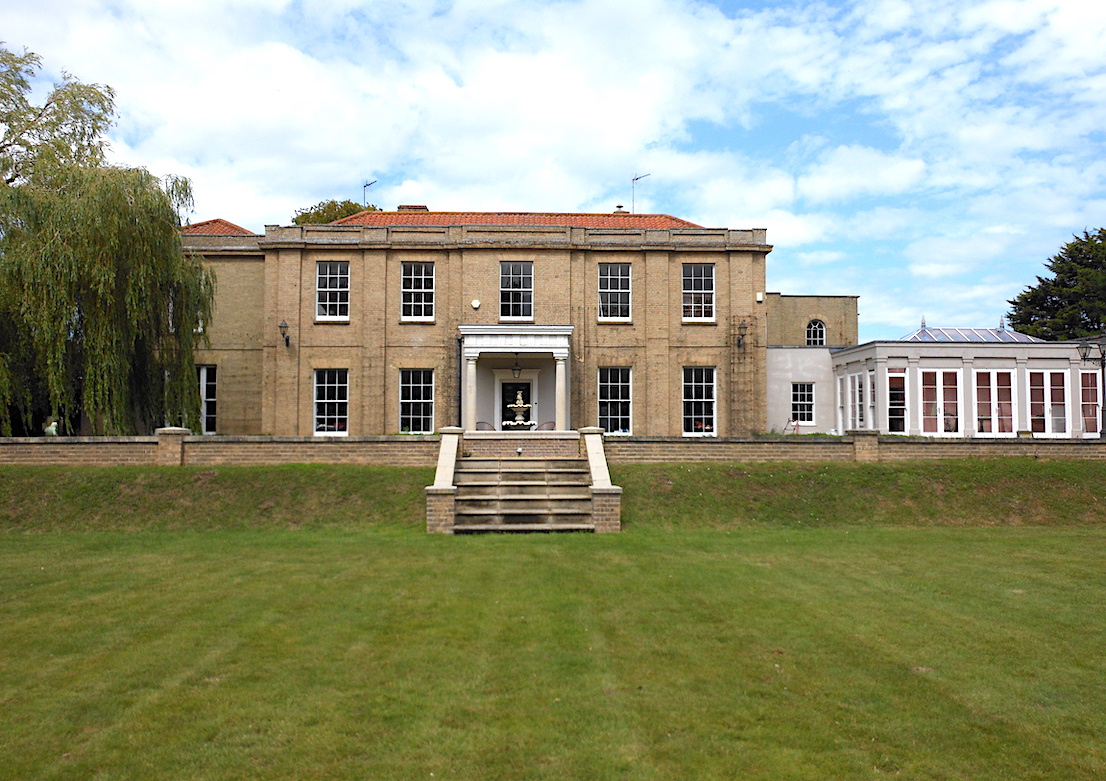
Langham Hall

The Hall was designed by Rev. Stephen Frost Rippingall and built in 1819 for his father, Thomas Rippingall. When Thomas died in 1834 his only surviving son, Stephen, came to live there. He had been a curate at Runton; he married the daughter of the rector and they had twelve children. In 1856 the house was occupied by Charles Rippingall, who then became the Lord of the Manor.

Stephen Frost Rippingall died in 1858, whereupon the Hall and its estate passed to his son William. He farmed there until his death in 1880, when it was bequeathed to his eldest surviving daughter, Horatia. As Lady of the Manor she lived there with her sisters, active benefactresses in the village.

In 1910 she sold the Hall to Carlos E Ryder. In 1916 he bought the Manor House at Binham and his son, Frederick Budd Ryder, took up residence.

In the Second World War the Hall was requisitioned by the RAF as a Casualty Reception Station: some of the less reverent and more active patients amused themselves by shooting at the church clock.

The Orangery

Since then there has been a succession of owners, including Mr M H Armistead, headmaster of a private school in Walsingham: he sold the Hall to Mr R M Peel in 1974 for approximately £55,000. The last-but-one owner was Mr Tony Burlingham, the proprietor of MJB Hotels.

This review seems fairly typical for an MJB hotel. Mr Burlingham himself has also been in the news now and then. The website for ‘MJB Langham Hall Apartments’ is still up and tells us that the ‘3-star Langham Hall Langham lies approximately 2.4 miles away from Blakeney Conservation Duck Pond Animal Park’.

The Hall was recently on the market for £1.95 million and has been purchased by the Cutmore-Scott family to incorporate with their adjoining hotel, The Harper. At present they are refurbishing – or should one say rescuing? – the old girl. There is a great deal to be done to bring her up to standard, but in time she will once again be an asset the village can be proud of.

The North Street entrance

Saturday, 22 July 2023

The Langham Martyrs

The publication of William Tyndale’s New Testament in 1526 accelerated the spread of Protestantism from the Continent. Printed abroad and smuggled into Catholic England, the body of translations popularly called the Tyndale Bible was the first English Bible to be mass produced: there were probably 16,000 copies in England by 1536.

Not everyone was receptive to the changes sweeping across the country. In November that year, John Smyth of Wighton was returning home from London when he happened to meet on the road one Ralph Rogerson, a yeoman farmer employed by Walsingham Priory as a ‘singing man’ or lay chorister.

The two of them continued their journey together, and as they did so bemoaned the cruelties and injustices being perpetrated in the name of religion. Two years earlier Henry VIII, by means of the first Act of Supremacy, had rejected Rome and founded the Church of England, appointing himself its supreme head; yet in 1521 he had been declared ‘Defender of the Faith’ by Pope Leo X in respect of a pamphlet he had published accusing Martin Luther, the seminal figure of the Protestant movement, of heresy.

In 1544, ten years after the first Act of Supremacy, Parliament sarcastically bestowed this selfsame title on its renegade sovereign.

The Act had had a long gestation. Henry’s first wife, Catherine of Aragon, had been his late brother’s wife and it had needed a special dispensation from Pope Julius II to allow the wedding to take place. She failed to provide him with a son and heir; in the mean time he had fallen in love with Anne Boleyn. He wanted to marry her, but Pope Clement VII refused to annul the existing marriage.

Henry VIII, from a portrait by Hans Holbein

The Catholic Church wielded great power in England. It was immensely wealthy and enjoyed privileges denied to the laity. It was also seen as corrupt doctrinally, financially and morally. Such practices as simony did not sit well with those who yearned to go back to a simpler and more faithful adherence to scripture – before Tyndale, personal exposure to the Bible outside the priesthood had been possible only for the minority who could read Latin. The Church had also become tainted by stories of sexual misconduct in religious houses.

Henry’s rejection of Rome was expedient on three levels. He could see the way the Protestant wind was blowing; the wealth of the Church made a tempting target for a monarch who always wanted more; and of course, once free of the Pope’s intransigence, he could marry whomever he pleased.

His policies, as well as other grievances, led in October 1536 to the Lincolnshire Rising, when religious conservatives rioted against the king’s commissioners in protest at the suppression of the monasteries and the looting of their treasures.

Plaque commemorating the Lincolnshire Rising, at St James’s Church, Louth
Image credit: Sjwells53; licence

It was brutally put down, but was followed almost immediately by a far more serious rebellion in Yorkshire involving thirty thousand men at arms. This, known as the Pilgrimage of Grace, was likewise quashed and ended in the execution of over two hundred and twenty men.

The unrest was not restricted to Yorkshire and Lincolnshire. It should be understood that the gentry were participating, sometimes zealously, in the dismantling of the Catholic Church in this country and were often made gifts of its land. Together with long-held, simmering economic resentments and the fact that north Norfolk was especially conservative in matters of religion, the threat to Walsingham Priory was provocative in the extreme. Even after 1534 the shrine of Our Lady continued to attract pilgrims, and it had a special place in local people’s hearts.

On that November day in 1536, as John Smyth and Ralph Rogerson decried at length what was going on, they inflamed one another to the point where Smyth is said to have proposed an insurrection against ‘great men’ with himself as its leader – though later he would deny everything. The chief object was to spare Walsingham the fate of other religious houses that had been or were in the process of being broken up.

The proposal was as naive as it was reckless. The conspirators were to seize some of the more overbearing landowners together with their land, and so bring their grievances before the king.

The Walsingham Conspiracy, as it became known, never got beyond the planning stage. Someone reported it to Sir John Heydon of Baconsthorpe, who at once contacted Richard Gresham in London and Sir Roger Townshend at East Raynham. About 25 conspirators were arrested, all from north Norfolk. Three were from Langham: Thomas Manne, a carpenter; John Sellers, a tailor; and none other than the vicar, John Grigby or Grigbie.

Smyth and Rogerson, the original conspirators, escaped with their lives. So did Grigby – how, it is not known. Manne and Sellers were among the eleven men condemned to death. To broadcast the authorities’ salutary message, the executions were carried out at four different places: Lynn, Walsingham, Norwich and Yarmouth. Manne was executed at Norwich on 26 May 1537; Sellers followed him two days later, at Yarmouth.

The mode of execution, hanging, drawing and quartering, was exceptionally barbarous. The condemned man was dragged through the streets behind a horse, with or without the support of an old door or something of that sort. A crowd of spectators would follow, while more would be waiting at the gallows. The convict was hanged but taken down half-alive and, still conscious, emasculated. His abdomen was then slit open and his intestines drawn out. If by this time he had not succumbed to death he certainly did so next, when he was beheaded. Finally his body was ‘quartered’ – cut into four, boiled, and hung up in sundry public places to drive the lesson home.


The executions at Walsingham were performed just outside the town, at a place now called ‘Martyrs’ Field’, in the angle formed by the junction of Egmere Road with Station Road. Today it is just a nondescript bit of pasture populated by rabbits. There is nothing there to commemorate its grisly past, nor to remind us of the tumult that birthed the Church of England.


Saturday, 15 July 2023

Feudal Langham

When the Normans arrived in 1066, Langham would have been a farming village using a system of cultivation originating with the first Anglo-Saxon settlers. Its chief characteristic was the open field – a large area of unenclosed land divided into a number of arable strips. These were measured according to the ‘rod’, ‘perch’ or ‘pole’, five and a half yards. Strips were four poles wide and twenty or forty poles long, so that a forty-pole strip covered an area of one acre. Its length, two hundred and twenty yards, made a furrow’s-length or furlong. The ‘pole’ has largely fallen out of use, but it is nice to know that the cricket pitch is, internationally, still four poles long.

Each farmer had a certain number of strips, scattered over the field and mingled with his neighbours’. The lord’s strips could be mixed in with these also. There was little call for hedges or fences, though movable hurdles of willow or hazel could be brought into use when needed. Regions of better soil-fertility in different parts of the field were thus more fairly shared. The whole enterprise called for close community cohesion, so that at harvest-time, for example, everyone – except the lord and his household – reaped on his neighbours’ strips as well as his own.

The chief crops were einkorn, rye, barley and oats, supplemented by peas and beans, though there were regional variations and it is impossible to know what mix of these was cultivated here.

At harvest in inland places the ears of cereals alone would be cut off, using sickles, and the straw used for thatching and fodder, but at settlements within reach of extensive reed-beds, the stalks were often cut near ground-level, since reed is a much better thatching material than straw. In that case the stalks would be used as fodder once threshing was over.

Besides arable crops there were meadows, also cultivated on communal principles. After the harvest and hay-making, these and the arable would be opened up for common pasture, in Anglo-Saxon times the grazing rights being ascribed to each man by rulings of the village as a whole, again ensuring a sharing of resources.

As to livestock, sheep were important and would become increasingly so, especially in Norfolk. In spring and early summer cattle browsed the young and tender foliage at and near the edges of woodland, while pigs in particular were allowed to forage deeper in the woods for acorns, beech-mast, fungi, and whatever else they could find – Langham at that time, like the rest of England, was more heavily wooded than it is today.

Little is known about Anglo-Saxon agricultural implements. A hoard of tenth-century tools found in Lincolnshire contains an iron hoe-sheath and a bill-hook. The type of plough in use was almost certainly an ard.

Ploughing with an ard in Ethiopia
Image credit: Rod Waddington; licence

Towards the end of the period, just before the arrival of the Normans, there is a hint (e.g. in the Luttrell Psalter) that a plough with a mouldboard might have been used. This more efficient plough was certainly used after 1066 and on into the rest of the Middle Ages.

In Norman England, certainly, the soil was tilled with oxen pulling such a plough, and it was the ridges or ‘lands’ left by the mouldboard which divided one man’s strip from another’s. This so-called ‘ridge and furrow’ system persisted into Tudor-Stuart times. The outline of many of these strips in what is now pastureland is a common feature of the landscape today, often clearly visible, especially in aerial photos.

The strip system was efficient, provided the object was to feed the village rather than supply the market. In a typical village there might have been three or four such open fields, rotated in use so that one could be fallowed.

Land tenure

The word manor arrived with the Normans. In France it had simply denoted a seigneurial residence, but in England came to mean a form of social structure in which land was divided between the lord’s ‘demesne’ and land held by tenants in return for cash, produce, labour, or military service. Later, military service could be commutable to payment in the form of scutage or shield-money.

Elements of the manorial system pre-dated the Conquest and, like the mix of crops, varied across the country. On arrival the Normans would have found some of them familiar. But the Normans, descendants of the Vikings, were warlike people whose organisation depended on ferocious loyalty up the whole chain of command. William the Conqueror swept away the ancient Anglo-Saxon system of ‘booklands’ and ‘folklands’, with all their legal complexity, and took everything but church-lands for himself.

A scene from the Bayeux Tapestry depicting King William

The social structure was pyramidal. The king regarded himself as a vassal of God, a vassal being someone who has an obligation to a suzerain. William, as suzerain, appointed vassals of his own, and these, suzerains in turn, appointed their own vassals, all the way down the pyramid.

William’s vassals were the barons (‘men of the king’), to whom were granted tracts – sometimes very extensive – of land. Each of these men repaid the king with an oath of absolute loyalty and was required to provide military service as well as proceeds from the exploitation of his tenancy.

A baron was thus a mere tenant of the king. His own tenants owed him fealty too. The number of tenants in a manor varied, as did the activity of its lord in cultivating his demesne. Tenants were freemen; below them were the serfs, and below these, at the outset of the feudal system, there were also slaves: slavery had been an important feature of the Anglo-Saxon economy. In that economy slaves were recruited as the spoils of war. Many male slaves worked in pairs as ploughmen; female slaves might be dairymaids or discharge other menial duties, while in some households slaves performed less lowly functions. The Domesday Book of 1086 lists about 28,000 slaves, fewer than had been counted in 1066, and slavery in medieval England died out altogether by about 1150.

The Church operated in parallel with the Crown, though the Anglo-Saxon clergy were almost all deposed and replaced with Norman or at least compliant churchmen. Before the Conquest, Langham was held by Guert, a brother of King Harold; both were killed at the Battle of Hastings. In 1086 William bestowed Guert’s holdings on the Bishop of Thetford, William de Beaufeu (aka William of Bello Fargo or William of Belfou); the bishopric of East Anglia was moved from Thetford to Norwich in 1094 in readiness for the completion of the new cathedral there.

Serfdom

In Norman England there were various classes of serf, a serf being a peasant tied to the lord himself (a ‘villein in gross’) or to the manor (a ‘villein regardant’). A villein in gross was owned by the lord, but was not a slave.

The villein regardant owed his lord servitude in return for accommodation and the right to cultivate land (generally about 30 acres), and he was usually required to provide taxes or rents in the form of produce from his strips. He owned a pair of oxen which were teamed with three pairs of his neighbours’ to pull the plough; the lord typically owned four plough teams. He was required to spend part of his time working on the demesne, could not leave the manor without permission, and held his status by birth, so that if you were a villein regardant your children would be villeins regardants too. It was possible, however, with the lord’s consent, to gain manumission and become a freeman.

The villeins in gross laboured on five or fewer acres and did not own oxen or horses.  Below the villeins in status were the cottars or cottagers, also called bordars, who were labourers working merely in lieu of food and rent, sometimes also growing food for themselves on small plots of land.

The Domesday Book records that the population of England comprised on average 12% freeholders (note that only the king and the Church owned land: a ‘freeholder’ was a freeman tenant), 35% villeins, 30% cottars and 10% slaves, the latter rising to 25% in Cornwall.

In 1086 there were in Langham 31 villeins, 4 cottars and 5 slaves. The two churches owned between them 16 acres. Besides the strip-fields there were six acres of meadow and a mill. At this time windmills had not been built in any number in England, so this was almost certainly a watermill, implying perhaps that the flow of our branch of the River Stiffkey was more copious then, since no trace of a leat has yet been found.

The manor was managed by a bailiff, the equivalent of the Anglo-Saxon reeve.


The term ‘feudal’ derives from the medieval Latin feodum or feudum which is translatable to the word ‘fee’ in two senses: ‘a tribute to a superior’ and ‘a perquisite or any allotted portion’. It describes a reciprocal relationship in which the senior partner has the greater benefit. Norman England can be seen as a form of top-down economy with the greatest benefit to the king, while yet allowing a high degree of local autonomy with all the advantages that brings. It was stable enough to have lasted into the middle of the fourteenth century and had a lasting effect on the English psyche.

The Anglo-Saxons were themselves invaders, traditionally led by the Germanic war-leaders Hengest and Horsa, who arrived on these shores after the departure of the Romans. By 1066 they had so much intermarried with the native Britons that a new and recognisable cultural identity had been established: they regarded themselves as the rightful possessors of the country. When their king was slain at the Battle of Hastings and the usurper William, on questionable legal grounds, seized the whole country and turned it into a feudality, resentment ran high to the point of armed resistance, culminating in the atrocities of the Harrying of the North: one of William’s earliest acts was to build the Tower of London to control the capital, and he embarked on a programme of castle-building throughout his realm.

The change in status between the common people and their new French overlords can even be traced in the language. The peasants tended the animals and cooked the food and their masters ate it: sheep, mutton (mouton); bull, beef (boeuf), pig, pork (porc). William’s canny distribution of land to his allies, many of whom were little better than thugs, marked the beginning of a class system which plagues England even to this day. As with the Anglo-Saxons, the years and centuries added a sheen of respectability to the titles conferred by William and his successors. A similar process occurred when Henry VIII grabbed the property of the Church with the first Act of Supremacy in 1534.

From the Norman Conquest, perhaps, we derived the national attitude to the French, whom we both admire and dislike, and on whom we have waged war at various points in our history.

It is not easy to imagine exactly how, day to day, the lower orders regarded their masters. In return for his bondage, the serf did receive some benefits. The lord was obliged to house him, he had access to the fruits of cultivation, and he was part of a structured community whose security was ultimately guaranteed by the king. If ill used he could appeal to his lord for justice. The time that a villein regardant had to spend working on or for the demesne could be as low as two days a week.

So not all was quite as horrible as it sounds, and though it took nearly a hundred years, the Normans did abolish outright slavery. The very worst aspect of serfdom was loss of freedom, but then which of us is truly free today?

In the next instalment of this chronicle we shall look at the Black Death, which at a stroke destroyed the feudal system and changed for ever the way we think about ourselves.

Saturday, 8 July 2023

The Langham Madonna

Long before the Norman Conquest, Langham was divided into two parishes: Langham Magna to the east (also called Langham St Andrew, Langham Episcopi and Bishop’s Langham) and Langham Parva to the west (also called Langham St Mary and Little Langham), each with its own church – St Andrew’s being of course in Langham Magna and St Mary’s in Langham Parva.
St Mary’s was situated at the fork of the Binham and Cockthorpe roads. It had stood there for at least five centuries but disappeared between 1535, when Henry VIII ordered a catalogue to be made of all church property, and 1552, when a national inventory of church goods was taken. The dedication to St Mary was folded in with St Andrew’s, which is why our parish church now has a double dedication. No burials have yet been found at the site, nor any other archaeological remains.

A survey of 1602 says this of Langham Parva: ‘The Church there is whollie ruynated and p’faned long since, by Mr. Calthorp, sometyme Lord and Patrone thereof, there are no p’rishners dwelling in the said towne.’ In 1743 the church of St Mary was described as ‘demolished beyond the memory of man’.

In the 16th century there was a movement throughout much of northern Europe for rejection of papal authority. The Catholic Church was seen as idolatrous and corrupt. Protestantism was on the rise; in England this took shape in the first Act of Supremacy of 1534, when Henry VIII rejected Rome and founded the Church of England, with himself as its head. During the next five years the Dissolution of the Monasteries would see church property being seized and much of it distributed to Henry’s allies and cronies among the gentry.

In July 1538 Prior Vowell of Walsingham Priory acquiesced in its demolition and helped the king’s commissioners to remove its treasures, notably the figure of Our Lady. For this he received an annual pension of £100, a hefty sum in those days. The site was sold to one Thomas Sidney for £90. As to what happened to the figure, there is considerable confusion. Some accounts have it taken to London to be burnt, while others say it remained in Norfolk and was destroyed there.

Before the Reformation Walsingham was one of the most revered places in the Catholic world, drawing pilgrims from far and wide, as indeed it does to this day. Its desecration is bewailed in the contemporaneous ‘Lament for the Priory of Walsingham’:

In the wrackes of Walsingam
Whom should I chuse
But the Queene of Walsingam
To be guide to my muse?

Then, thou Prince of Walsingam
Graunt me to frame
Bitter plaintes to rewe thy wronge
Bitter wo for thy name.

Bitter was it, oh to see
The sely [innocent] sheepe
Murdred by the raveninge wolves
While the sheepharde did sleep.

Bitter was it, oh, to viewe
The sacred vyne
Whiles the gardiners plaied [plaited] all close
Rooted up by the swine.

Bitter, bitter oh to behoulde
The grasse to growe
Where the walles of Walsingam
So stately did shewe.

Such were the worth of Walsingam
While she did stand
Such are the wrackes as now do shewe
Of that so holy lande.

Levell, levell with the ground
The Towres doe lye
Which with their golden, glitt’ring tops
Pearsed oute to the skye.

Where weare gates noe gates are nowe,
The waies [pathways] unknowen,
Where the presse [crowd] of freares [friars] did passe
While her fame far was blowen [trumpeted].

Oules [owls] do scrike where the sweetest himnes
Lately wear songe,
Toades and serpents hold their dennes
Where the palmers did throng.

Weep, weep O Walsingam,
Whose dayes are nightes,
Blessings turned to blasphemies,
Holy deedes to dispites [crimes].

Sinne is where our Ladye sate,
Heaven turned is to helle;
Sathan sitte where our Lord did swaye,
Walsingam, oh, farewell!

            — Anonymous

It is not unusual for two churches to be near one another in Norfolk, as at Wiveton and Cley, so what happened to St Mary’s? A possible clue is in the name.

Thanks to Henry’s largesse to the ruling class, much of it was quick to welcome the new Protestant order. Much of the peasantry, however, clung to the comfort of the old religion and its rituals. This was especially true in the countryside, and especially so in the remote countryside of north Norfolk. Matters were not helped in many hearts by a deep-seated resentment of the gentry, a phantom of the hatred of the Anglo-Saxons for their Norman overlords; many of the contemporary gentry could trace their lineage back to France.

Michael Medlar, in his study (pdf) of early sixteenth century Langham wills, finds that bequests were made by villagers to ‘Our Lady of Tofte’. One in particular, the largest, of £45 in land and goods, was made by one Oliver Dawbeney on 27 October 1532, two years before the first Act of Supremacy. Barendina Smedley speculates that there may have been a figure of the Virgin Mary venerated in St Mary’s named Our Lady of Tofte, though she leans more to the idea that there was a now-vanished chapel for the figure next to the present north door of St Andrew’s.

The origin of the name is clouded in mystery and may have a connection with the hamlet of Toftrees, south of Fakenham, which in the past was called ‘Tofte’ or ‘Toftes’.

Stephanie A Mann notes that a wooden statuette of the Virgin and Child at the Victoria and Albert Museum, dated to about 1220-30 and still bearing traces of paint, goes under the name of ‘The Langham Madonna’.
The Walsingham Seal

She also notes that, while the Langham Madonna is said (on no evident authority) to have come from Langham in Essex, it bears a close resemblance to the figure in the Walsingham Seal; and she speculates that Our Lady of Walsingham may have been spirited away to a local but out-of-the-way site of Marian worship – St Mary’s, Langham, Norfolk: for the Calthorpes of Langham Hall (not the Hall by the crossroads, but an earlier one, now lost) were known to be recusants, and the vicar of Langham, John Grigby, was arrested for his part in a conspiracy which tried to resist the dissolution of Walsingham Priory.

We are unlikely ever to know what happened. Could it really be that the ‘ruynation’ of St Mary’s, so expeditiously carried out by ‘Mr. Calthorp, sometyme Lord and Patrone thereof’, included the further spiriting away of that iconic artefact of ‘popery’? And could it be that the arrest of the conspirators persuaded Mr Calthorpe thus to distance himself – and his dangerous reputation as a recusant – from John Grigby and so protect his person, his family and his lands from men of even higher rank and influence?